Raven Metadata Extractor
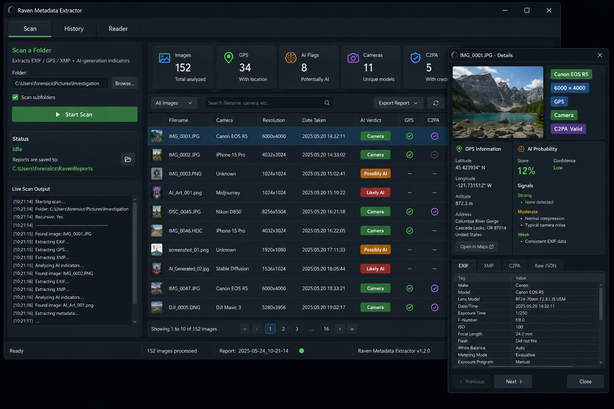
Cross-platform desktop and CLI tool for explainable image metadata reports across EXIF, XMP, GPS, C2PA, and bounded AI-origin indicators.
Software Engineer & Systems Architect
Author of BOUND Method v3.0 — Boundary-Oriented Unified Development
Working across software architecture, complex systems, AI-assisted engineering, and technical-method design — making boundaries, contracts, and verification paths explicit and traceable.
// 01 — PROFESSIONAL FOCUS
The work spans software architecture and complex systems, then extends into AI-assisted engineering, verification discipline, and implementation. The common thread is explicit responsibility.
Responsibility boundaries, modular decomposition, contracts, ownership, and system shape.
BOUNDARIES · CONTRACTS · OWNERSHIP
Local-first state, CRDT synchronization, protocols, runtime constraints, and distributed behavior.
CRDT · LOCAL-FIRST · PROTOCOLS

Structured execution contexts that constrain system-wide assumptions while preserving local implementation freedom.
TEAM BRIEFS · AGENTS · CONSTRAINTS
Contract verification, evidence limits, secure boundaries, encrypted local state, and provenance-aware tooling.
CI · C2PA · EVIDENCE · SECURITY
▊Kotlin, Rust, Python and platform engineering with explicit interfaces and testable boundaries.
KOTLIN · RUST · PYTHON · CI
// 02 — SYSTEMS IN PRACTICE
Four compact instruments make recurring systems ideas tangible: signal composition, decision logic, reversible data transformation, and emergent complexity. Together they connect software, security, communications, and mathematical reasoning through direct interaction.
Superposition: y(t) = A·sin(2πf₁t) + B·sin(2πf₂t). The white trace is the composite signal.
Click the inputs. The lamp shows the boolean output.
C = P ⊕ K. XOR is the primitive inside every modern stream cipher.
The Mandelbrot set: z ← z² + c. Infinite complexity from a two-line recurrence.
Iterations: 80 · Plane: [-2.2, 0.8] × [-1.2, 1.2]
// 03 — ENGINEERING CASE STUDIES

Cross-platform desktop and CLI tool for explainable image metadata reports across EXIF, XMP, GPS, C2PA, and bounded AI-origin indicators.

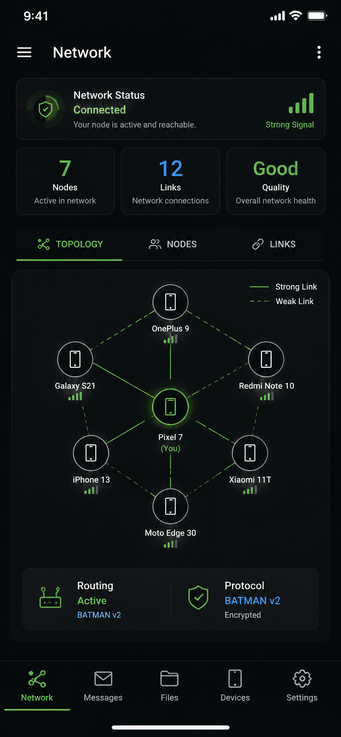
Offline Android peer-to-peer communication prototype combining Kotlin, Rust, Bluetooth LE, Wi-Fi Direct, and encrypted local storage for off-grid messaging scenarios.

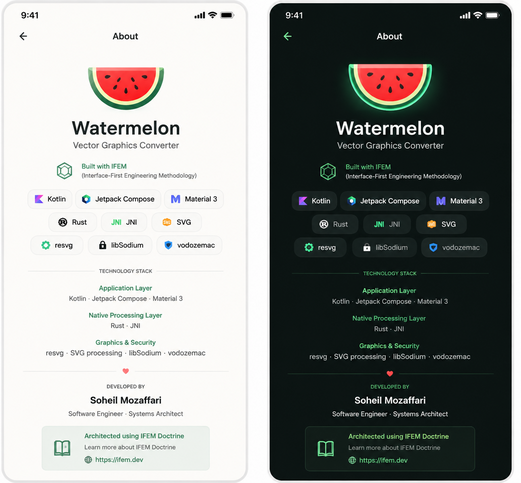
Native Android graphics-processing application with separated application and processing layers and explicit execution boundaries.

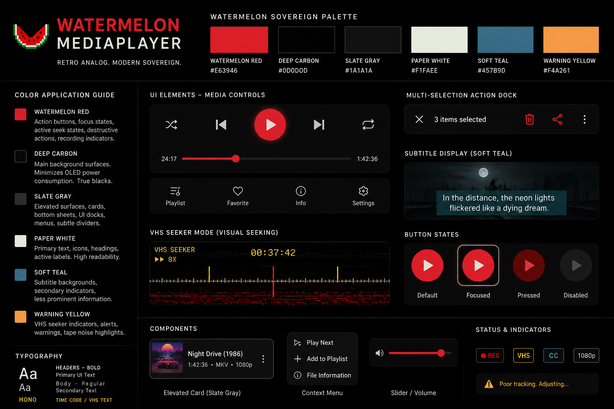
Privacy-oriented offline Android media-player architecture built around explicit Kotlin interfaces, modular playback/storage/subtitle boundaries, and RTL-aware product design.

Rust-centric mission-operations architecture spanning local-first synchronization, persistence, observability, client surfaces, transport layers, and deployment infrastructure.

Earlier methodology and publication lineage centered on explicit interfaces, contracts, responsibility boundaries, and independent verification.

// 04 — METHODOLOGY
BOUNDARY-ORIENTED UNIFIED DEVELOPMENT
BOUND is a software engineering methodology for reliable parallel development. It starts by making responsibility boundaries explicit, formalizes what crosses them as contracts, enables independent implementation, and verifies conformance continuously.
Boundary
Contract
Independent Execution
Continuous Verification
“Define the boundaries. Freeze the contracts. Execute independently. Verify continuously.”
From IFEM to BOUND: BOUND v3.0 is the renamed continuation and conceptual refinement of IFEM. IFEM: Interface → Contract → Execution → Verification. BOUND: Domain → Boundary → Contract → Execution → Verification. Interfaces emerge from boundaries; boundaries should not be inferred from interfaces.
// 05 — PUBLICATIONS & TECHNICAL WRITING
Canonical publications first; unpublished LinkedIn article URLs are not invented.
PRIMARY PUBLICATION · ZENODO
Version 3.0 · 2026 · DOI 10.5281/zenodo.22257583
LINEAGE PUBLICATION · ZENODO
Version 2.2 · earlier methodology / BOUND lineage